Flat-Rate vs Per-Employee Pricing: What Workforce Management Software Really Costs
Per-employee pricing means your software bill rises every time you hire, add a client or open a site, while flat-rate pricing stays the same. For a growing security, cleaning or FM company, the difference compounds quickly. MonitorGuard plans start from £250 per month for unlimited sites, staff and clients, after a free 30-day pilot.
This guide explains the common pricing models, shows how the cost changes as you grow, and gives you questions to ask any supplier. We compare models fairly, including where a competitor may be cheaper for you.
The three common pricing models
- Per employee (or per user). You pay a set amount for each person in the system each month. Staff, supervisors and managers may all count.
- Per hour or usage. You pay for the scheduled hours the system manages, usually in tiers.
- Flat rate. One price for the platform, regardless of how many people, sites or clients you add.
What other providers publish
Prices read from public pages on 15 November 2026:
|
Provider type |
Pricing model |
Published price |
|---|---|---|
|
Per-hour provider |
Per scheduled hour, with unlimited users |
Entry plan £119 per month (2,500 hours included); next plan £299 per month (4,500 hours included); custom above that. Rate for extra hours not published |
|
Quote-based provider |
Quote based on the average number of active guards per month |
No prices published; request a quote |
|
MonitorGuard |
Flat rate |
From £250 per month for unlimited sites, staff and clients, after a free 30-day pilot |
These providers do not all price the same way, and the plans do not include identical features, so treat this as a guide to cost structure rather than a feature-for-feature comparison.
How per-employee pricing scales
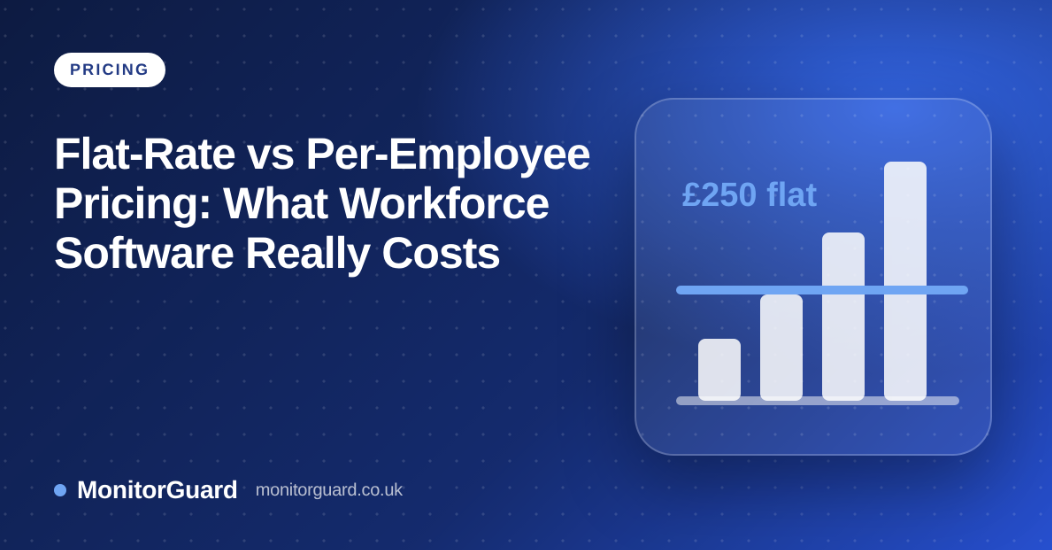
The table shows the monthly cost of three illustrative per-employee rates against a flat £250. The rates are examples for illustration, not any named supplier's price. Substitute your own quote.
|
Staff in the system |
At £3 per employee |
At £5 per employee |
At £8 per employee |
MonitorGuard (from £250) |
|---|---|---|---|---|
|
20 |
£60 |
£100 |
£160 |
£250 |
|
50 |
£150 |
£250 |
£400 |
£250 |
|
100 |
£300 |
£500 |
£800 |
£250 |
|
200 |
£600 |
£1,000 |
£1,600 |
£250 |
Where flat pricing wins: once your headcount passes the break-even point, which is £250 divided by the per-employee rate (about 83 staff at £3, 50 at £5, 31 at £8).
Where per-employee pricing can win: very small teams. A firm with 10 guards at £3 per employee pays less than £250. Be honest about where you are today and where you will be in 12 months.
Per-hour pricing: the same growth problem, in hours
Per-hour plans tie cost to the hours you schedule. Published tiers can be good value for smaller operations. The cost depends on how many hours you manage:
- At 2,500 scheduled hours per month or fewer, one published per-hour plan costs less than £250.
- Between 2,500 and 4,500 hours, the next published plan we found is £299, above £250.
- Above 4,500 hours you move to an extra-hours charge or a custom quote, which is not published.
To estimate your hours, multiply the number of shifts per month by shift length. A 24/7 post alone is about 730 hours a month. Ten such posts is about 7,300 hours.
The costs that do not show on the price list
- Who counts as an employee? Part-timers, relief staff, supervisors and back-office users can all be billed.
- Seasonal peaks. Hiring for a busy period can push you into a higher tier or a higher bill.
- Client and site charges. Some suppliers charge extra for clients, sites or modules.
- Setup and training. Check whether these are free or charged.
- Support. Check whether phone and chat support are included.
- Add-ons. Patrol hardware, extra modules and integrations can add to the total.
- Contract length. Annual lock-ins increase your risk if the fit is wrong.
Why flat-rate pricing helps a growing firm
- Predictable budgeting. You know your software cost before you win the next contract.
- No penalty for growth. Adding a guard, a client or a site costs nothing extra.
- Easier tendering. You can price contracts without a per-head software cost.
- Everyone in the system. You can give supervisors, clients and office staff access without counting seats.
With MonitorGuard you get geo-fenced attendance, scheduling, virtual checkpoints, incident reporting, timesheets, role-based access and dedicated support under one price, with free setup and training.
Questions to ask any supplier about price
- What exactly do you charge for: employees, hours, sites, clients or modules?
- Who counts as a user?
- What happens to my bill if I double my headcount?
- What is the rate once I exceed my included allowance?
- Are setup, training and support included?
- What is the minimum term, and can I leave?
- Can I try it with real shifts first?
Frequently asked questions
Is per-employee pricing more expensive than flat-rate pricing?
It depends on your headcount. Per-employee pricing can be cheaper for very small teams and becomes more expensive as you grow past the break-even point.
How much does security guard scheduling software cost?
Prices vary by model, from a few pounds per employee to flat monthly fees and per-hour tiers. Some suppliers publish no prices and quote based on your number of guards.
Does MonitorGuard charge per user?
No. Plans start from £250 per month for unlimited sites, staff and clients, after a free 30-day pilot with no credit card needed.
How do I calculate my software cost per employee?
Divide the monthly price by your number of staff. With a flat rate, the cost per employee falls as your team grows.
Final thoughts
The cheapest software on day one is not always the cheapest in year two. Model your costs at your current size and at the size you plan to be.
Want to see what a flat rate saves your business? Book a MonitorGuard demo or start a free 30-day pilot.