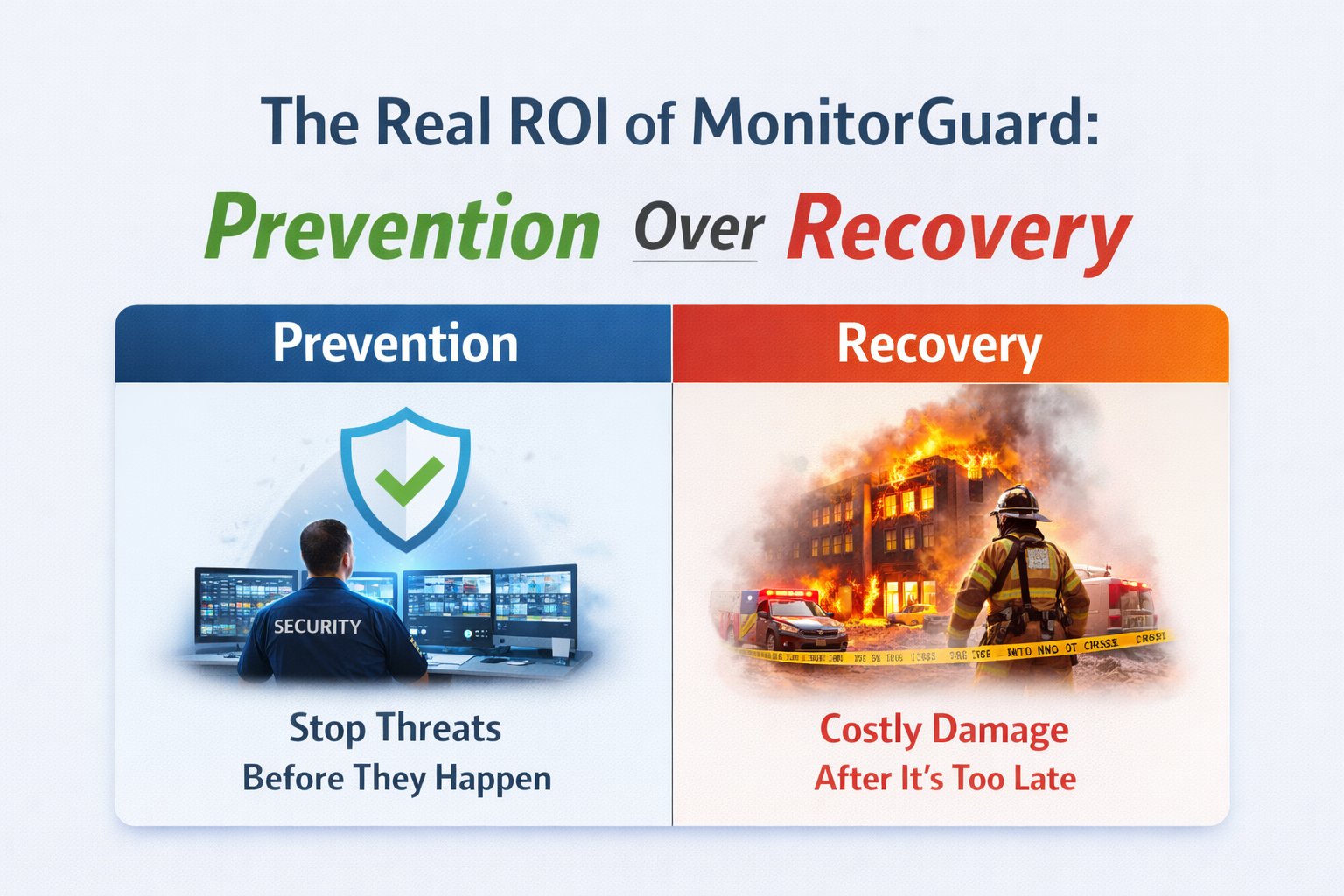
The Real ROI of MonitorGuard: Prevention Over Recovery
When organizations evaluate security investments, ROI is often calculated after an incident occurs - theft, damage, disruption, or compliance failure.But the real return on investment in security is not recovery.It is prevention.
MonitorGuard is designed to help organizations stop security issues before they turn into costly incidents, shifting security from a reactive function to a preventive operational system.
Understanding ROI in Security Operations
In traditional security models, ROI is linked to:
-
How quickly damage was handled
-
How efficiently reports were created
-
How well losses were recovered
However, these metrics only apply after failure.
True security ROI is measured by:
-
Reduced incidents
-
Lower operational risk
-
Fewer disruptions
-
Stronger control over daily security activities
This is where MonitorGuard delivers measurable value.
The High Cost of Recovery-Based Security
Recovery-focused security comes with hidden and recurring costs:
-
Asset loss and property damage
-
Business downtime
-
Management time spent on investigations
-
Compliance and audit risks
-
Reputational impact
Even when financial losses are recovered, operational stability and trust are often not.
Recovery always costs more than prevention.
How MonitorGuard Enables Prevention
1. Real-Time Operational Visibility
MonitorGuard provides live visibility into:
-
Guard activity
-
Patrol completion
-
Shift performance
-
Incident reporting
Managers no longer wait for end-of-day reports.
Risks are identified as they emerge, not after damage occurs.
2. Early Detection of Security Gaps
Missed patrols, delayed responses, and irregular activity are flagged immediately.
This allows teams to:
-
Correct issues early
-
Prevent escalation
-
Maintain consistent security coverage
Small lapses are addressed before they become serious incidents.
3. Accountability That Reduces Risk
When guard activities are digitally tracked:
-
Responsibilities are clear
-
Performance is measurable
-
Standards are consistently followed
This level of accountability significantly reduces human error - one of the biggest causes of security failure.
4. Centralized Control Across All Sites
For organizations managing multiple locations, MonitorGuard offers:
-
A single platform for all security operations
-
Consistent processes across sites
-
Easier comparison and risk analysis
Centralized control helps prevent overlooked vulnerabilities that often arise in fragmented systems.
5. Lower Long-Term Operational Costs
By preventing incidents, MonitorGuard helps organizations:
-
Reduce loss-related expenses
-
Minimize emergency responses
-
Simplify audits and compliance
-
Decrease reliance on manual supervision
The result is sustainable cost efficiency, not short-term fixes.
Prevention Creates Measurable ROI
Recovery-Based Security
-
Incident occurs
-
Damage is done
-
Costs are incurred
Prevention-Based Security with MonitorGuard
-
Risk is detected early
-
Action is taken immediately
-
Incident never occurs
No loss.
No disruption.
No recovery cost.
That is real ROI.
Why Organizations Invest in MonitorGuard
Organizations choose MonitorGuard because it:
-
Transforms security into a controlled operation
-
Reduces uncertainty and operational risk
-
Provides measurable performance data
-
Protects assets, operations, and reputation
MonitorGuard does not simply record security activities - it actively prevents failure.
Final Thoughts
The strongest return on security investment is often invisible - because the incident never happens.
By prioritizing prevention over recovery, MonitorGuard enables organizations to protect their assets, maintain operational continuity, and achieve long-term security ROI.
Security should not be measured by how well damage is handled.
It should be measured by how effectively damage is avoided.